
What a Rainbow Really Is, and What It Might Mean to You

A rainbow is not a thing in the sky you can touch; it is an optical event created by sunlight and water droplets working together. When sunlight hits a spherical droplet, the beam slows and bends (refraction); it then reflects inside the drop and leaves bent again. Different wavelengths (what we see as colours) bend by slightly different amounts, so the light fans out into the familiar band of colours. From the ground, we usually see an arc; from an aeroplane, you can sometimes see the entire circle. According to the Met Office, rainbows need three things: the Sun behind you, water droplets in front of you, and the Sun low enough in the sky (generally less than about 42° above the horizon).
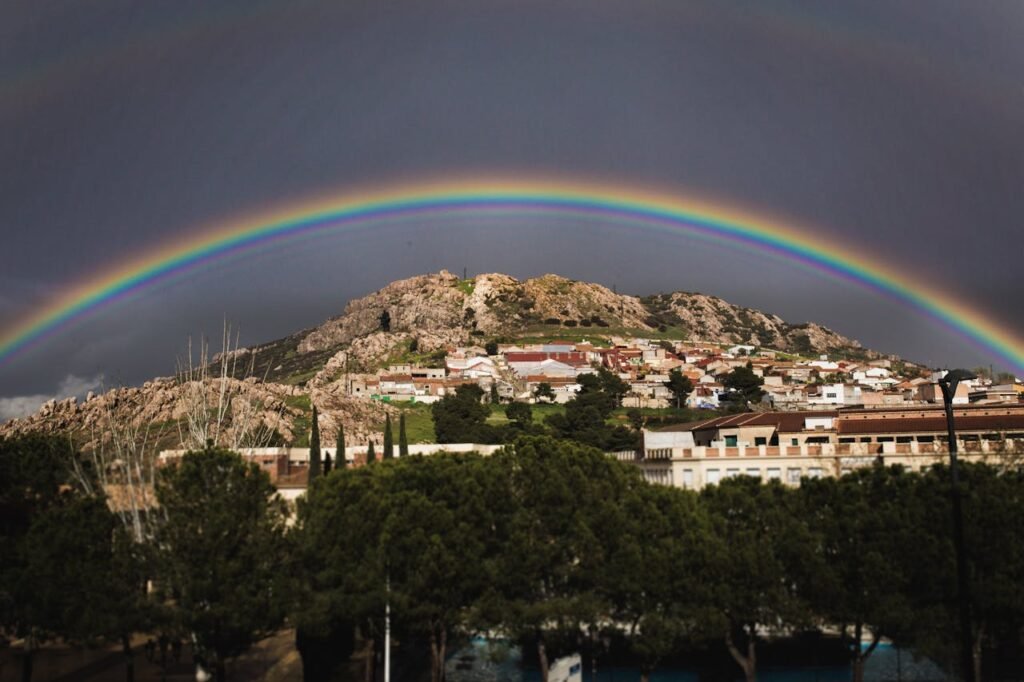
That geometry also explains double rainbows and the reversed colours you see in the faint outer arc. The outer, secondary rainbow is produced when light reflects twice inside a drop; the second reflection throws the visible wavelengths into a wider angle and flips their order. Government science pages used in education break this down with simple diagrams and explain why the bright band appears at about 42° for red light in the primary rainbow. According to NOAA, the secondary rainbow forms at a different angle (near 50° for red) and is dimmer because more light is lost during the extra reflection.

Real-life rainbows people remember
Rainbows often appear unexpectedly in people’s lives and news feeds, and real stories show how ordinary science can become an extraordinary human experience. For example, after a rainy April day in Minnesota, hundreds of people photographed a vivid double rainbow that stretched over towns and streets. According to CBS News, a local meteorologist explained the dark band between the arcs—known as Alexander’s dark band—and the reversed colours of the secondary bow. That gallery of images and the meteorologist’s brief explanation turned into a small, local moment that many people saved as photos.
Another recent, widely shared story on People.com came from a wedding on North Carolina’s Outer Banks in September 2024. A couple who had both been widowed said a double rainbow appeared immediately after a rainy morning, and while guests took pictures, the couple and many online viewers read the event as a blessing or sign from their late spouses. Personal testimony and social video made the rainbow a memorable public story that spread on social platforms.
Science stories also appear. In May 2025, NASA published images from the PUNCH mission in which polarisation maps were rendered as rainbow-coloured images to show structure in the zodiacal light and solar wind, not an atmospheric rainbow, but a helpful reminder that “rainbow” colours in science often stand for measured differences, not literal water-drop optics. According to NASA, those images give scientists new ways to see polarised light in space.
Not every rainbow moment is social-media friendly; some are small and local (a fogbow outside a cottage), some are rare optical cousins like moonbows and supernumerary bands, and some reveal serious science about light. Researchers have studied supernumerary arcs — the pastel, closely spaced bands inside a primary bow, and concluded they arise from interference between closely related light paths through droplets. That work is classic optical physics, showing rainbows can be both a backyard wonder and a laboratory subject. According to a study by P. Laven, supernumerary arcs provided historical evidence for the wave nature of light.
What a Rainbow Tells You: Weather, Science and Meaning
When you spot a rainbow, the simplest meteorological message is immediate and useful: the Sun is behind you, and rain (or spray, fog, a waterfall) is in front of you. That means rain has recently passed or is nearby; behind you, conditions are clearing. For practical outdoor decisions — finishing a walk, timing a drive, planning a backyard wedding — that quick reading can be more useful than romantic interpretations. According to studies, the angle and position of the Sun explain how much of the arc you will see and when (lower Sun = larger visible arc).
Scientifically, rainbows reveal properties of droplets and light. The presence of supernumerary bands or a very soft, washed-out bow points to small, uniform droplets (mist or fog), while very sharp, saturated colours can indicate larger, more uniform raindrops. Optical researchers use rainbows and related effects to test scattering models and to check detailed theories of wave optics. For instance, supernumerary arcs were historically crucial for showing that light behaves as a wave, and modern work continues to refine those models. According to the study by P. Laven, studying supernumerary arcs connects everyday observation to physics.
Culturally and personally, rainbows often carry meaning that goes well beyond physics. Humans have long read rainbows as signs, such as blessings, bridges, or symbols of peace, and modern social media multiplies those private readings quickly. Recent news stories (like the wedding account) show how people publicly interpret rainbows as confirmation, comfort, or closure; those meanings are real and important even if they are not scientific facts.
How to Chase, Photograph, and Safely Use a Rainbow: Actionable Advice
If you want to experience rainbows on purpose, here are reliable, practical steps you can use right away. First, place the Sun at your back and scan the part of the sky opposite the Sun after rain or near spray (waterfalls, fountains) or fog. Move until the arc becomes visible; small changes in your position can make a bow appear or vanish. According to NOAA educational guidance, a full circular rainbow can sometimes be seen from high vantage points or aircraft, while ground observers usually see only arcs.
For photography: use a wide lens, keep the Sun behind you, and expose for the sky (not the foreground) to bring out colours; if you include foreground elements — trees, buildings, people — make sure they are not in silhouette unless that is the look you want. If you want to capture supernumerary or faint secondary bands, use a longer focal length and bracket exposures (take several shots at different settings). Many local news galleries (like the Minnesota story) show how different camera choices change the images people share.
Safety and etiquette: don’t block traffic or stand on unsafe ground chasing pictures. If you’re near a storm, remember that distant rainbows mean rain is still active nearby—lightning can travel; do not put yourself at risk for a photo. If you’re at an event (a wedding, a memorial), be mindful that others may be giving private meaning to the rainbow; ask before you post images that include people. Lastly, seize the moment: rainbows are transient, often lasting only minutes. Keep a camera or phone ready, but take a few seconds first to simply look — people who later posted images often say the quiet, shared noticing was the best part.